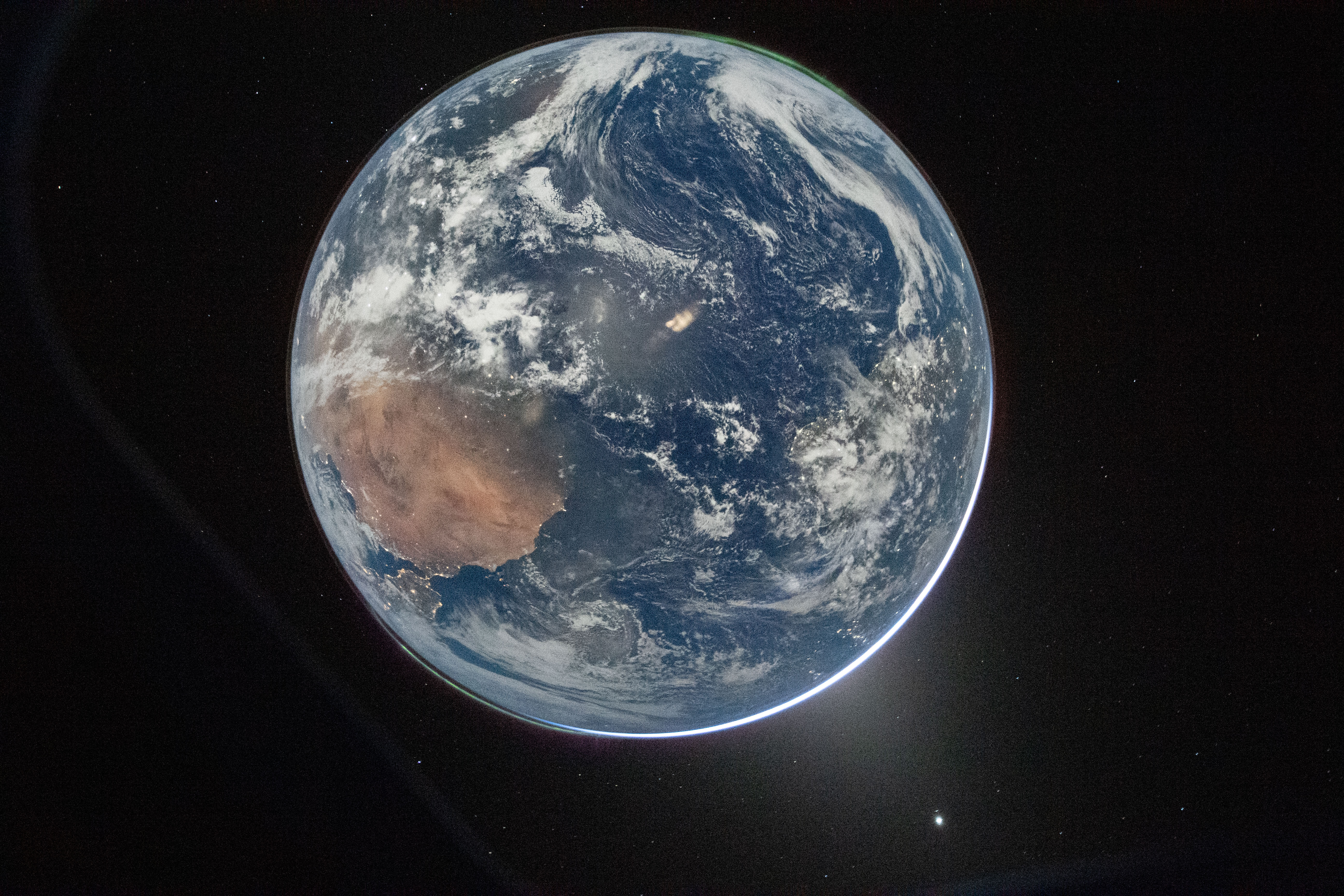
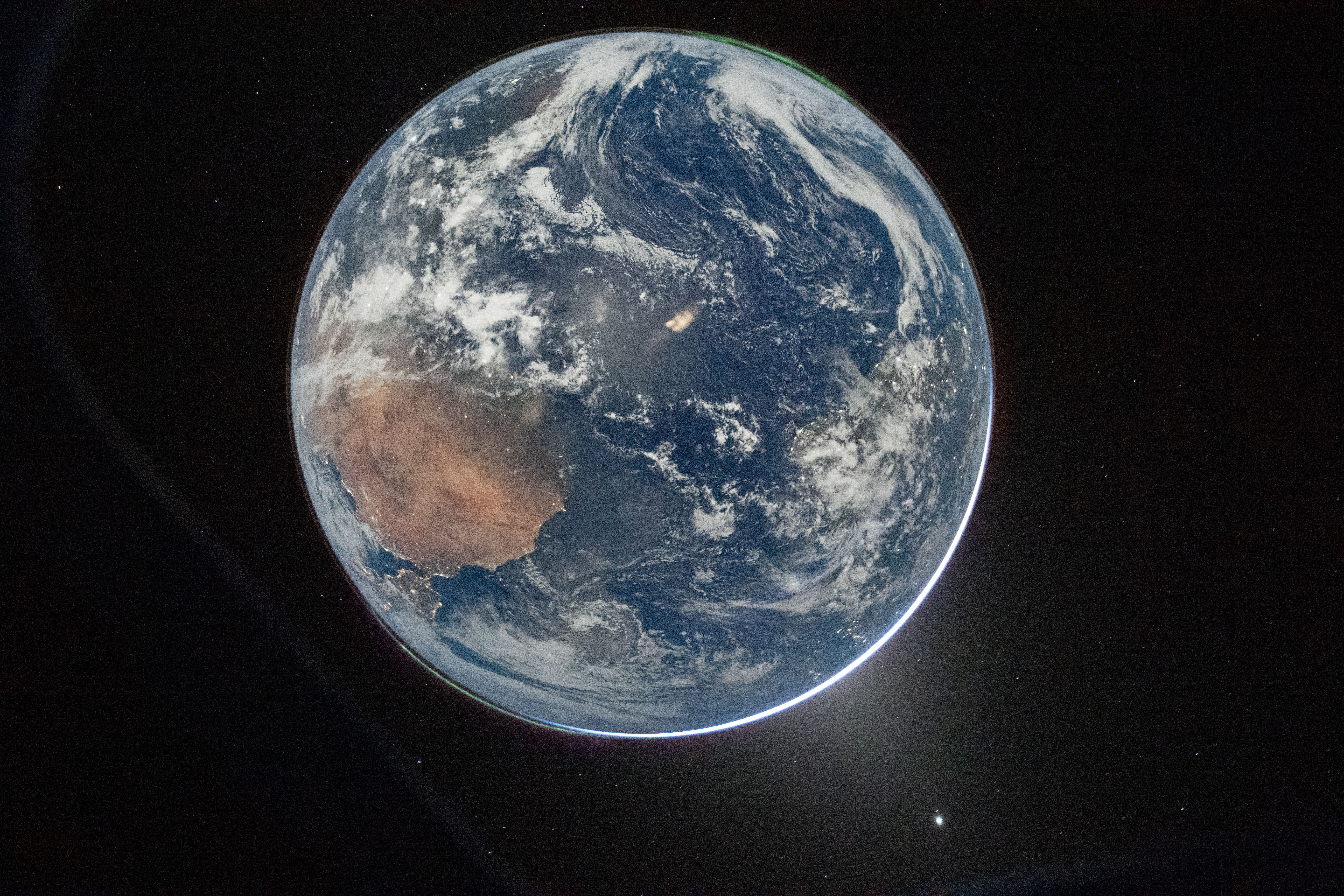
Artemis II crew take “spectacular” image of Earth
https://www.bbc.com/news/articles/ce8jzr423p9o
andsoitis · 3 months ago
https://www.nasa.gov/image-detail/fd02_for-pao/
72 comments
https://www.bbc.com/news/articles/ce8jzr423p9o
andsoitis · 3 months ago
https://www.nasa.gov/image-detail/fd02_for-pao/
72 comments
damnitbuilds · 3 months ago
Anyone find the full res version of this ?
Nasa images page is useless. Government work.
matteason · 3 months ago
They're here: https://www.nasa.gov/gallery/journey-to-the-moon/
Direct link to this image: https://www.nasa.gov/wp-content/uploads/2026/04/art002e00019...
mbauman · 3 months ago
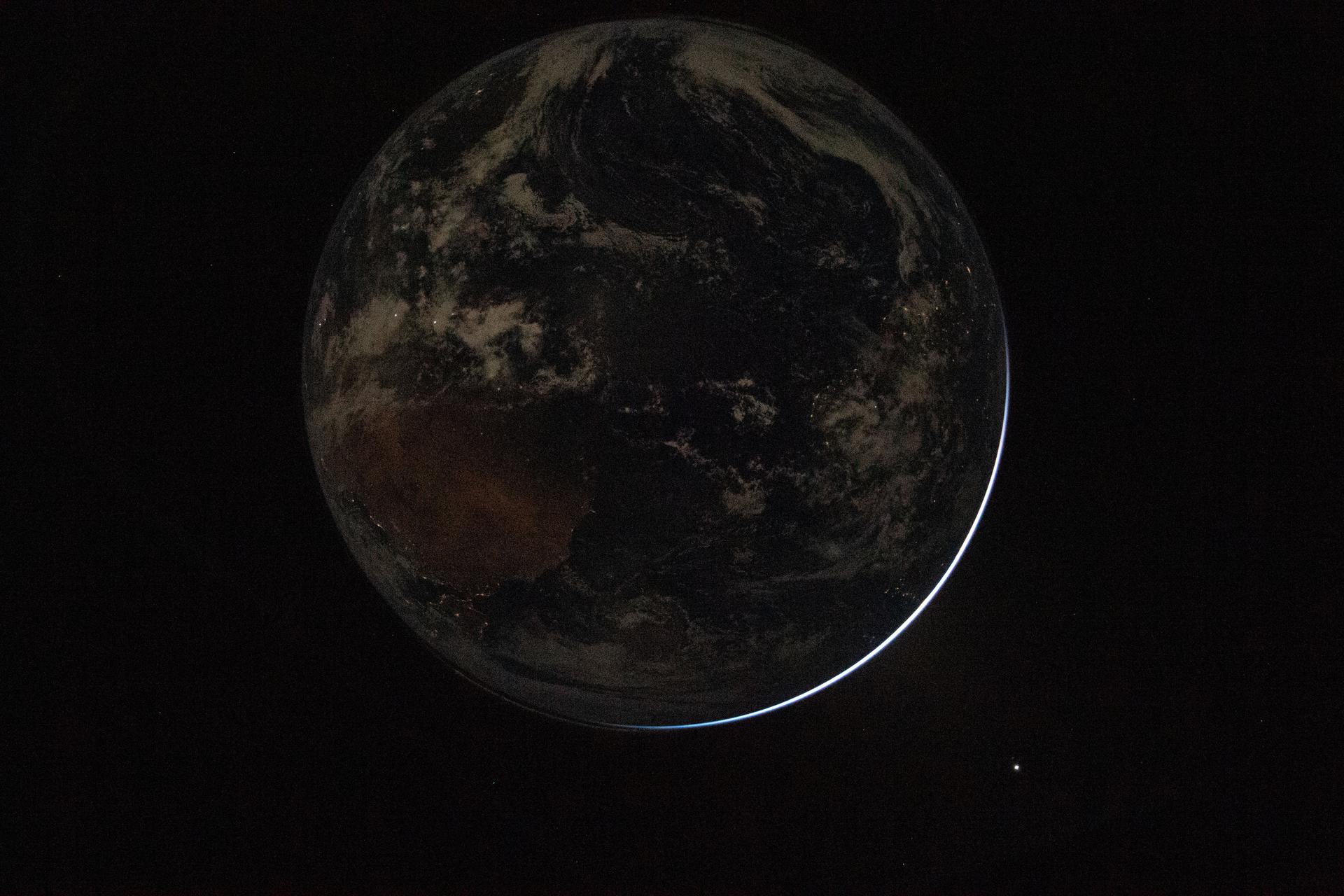
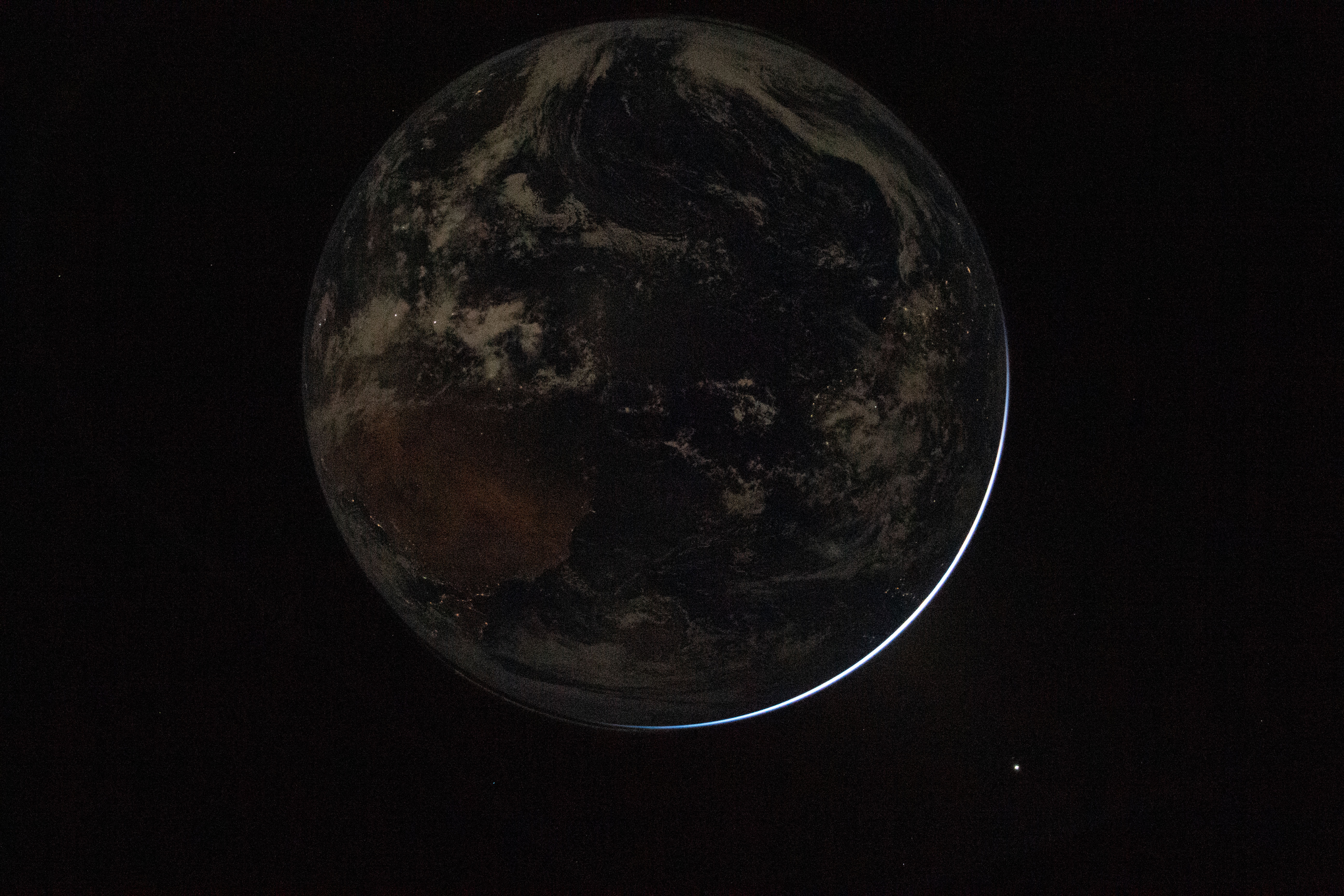
That version is ~~brightened significantly~~ (edit) a longer exposure; I like the darker one better.
Sharlin · 3 months ago
They're two separate photos, just taken at different exposure settings.
mbauman · 3 months ago
Sure enough, thanks for the correction!
damnitbuilds · 3 months ago
Jpeg.
Jordan-117 · 3 months ago
"I cannot immediately find a photo on a website, therefore I will denigrate the agency that sent people into OUTER SPACE to make these incredible images possible."
damnitbuilds · 3 months ago
NASA spends $4 billion PER ARTEMIS FLIGHT to throw reusable engines into the sea so people with influential representatives get jobs.
It is pork barrel politics at its very worse.
NASA has a lot to be proud of. but not Artemis. And not their Artemis website.
sgt · 3 months ago
I don't understand why media, such as BBC, keep uploading heavily compressed versions of photos that could be beautiful. The original has grain, sure but that's not a problem. The BBC version is horrific. Are they trying to save on bandwidth in 2026?
pndy · 3 months ago
If the content loads fast, more views are given and more data is collected.
My uBo caught 6 elements, Privacy Possum got referer headers blocked from 28 sources
BHSPitMonkey · 3 months ago
It's highly reasonable for them to limit image size/quality to whatever looks fine to 98% of their readers. They store and serve an absolute ton of ever-changing content to browsers/apps; The very small (and likely revenue-negative) contingent of highly motivated people can find the originals if the images are especially noteworthy like these.
sandworm101 · 3 months ago
Come on flat-earthers. I know you are out there. Lets hear your crazy rant about how this is a fisheye lens on a weather balloon or a webcam atop the eiffel tower. Why can't we see the poles? And is that an ice wall on poking up in the lower-right quadrant of the disk?
layer8 · 3 months ago
Don’t you see the reflection of the studio lighting in the middle?
geldedus · 3 months ago
of course they are sore losers
itsalwaysthem · 3 months ago
Flat Earth is a distraction or a way to ridicule any counter-narrative to anything scientific.
When a cosmologist says that a planet nobody can see exists and is made of x% helium and is y light years away etc etc with absolute certainty despite nobody being able to go there and witness any of it (look how wrong they were about Pluto’s appearance), then you can always just say “what are you a Flat Earther” and easily discredit any doubt I have in these extraordinary claims with underwhelming evidence.
Any idea you want the public to oppose, you can create and market an adjacent thing, like Trump. You can throw all the ideas you want to oppose in the Trump bucket and if anyone supports it it’s probably because they’re a Trump supporter right?
See you’re very very easily programmed, like clockwork.
kube-system · 3 months ago
> a planet nobody can see exists and is made of x% helium and is y light years away etc etc
Yeah, because this is high-school curriculum.
https://www.jpl.nasa.gov/edu/resources/lesson-plan/using-lig...
> with absolute certainty
It is taught that the scientific method provides evidence, not certainty, in middle school science curriculum.
TeMPOraL · 3 months ago
> It is taught that the scientific method provides evidence, not certainty, in middle school science curriculum.
FWIW, this fact isn't taught properly or normies are somehow unable to process it.
There's this popular dismissal of tech people, saying that "they think in 0s and 1s, but world is shades of gray", but in reality, it's almost everyone else that thinks in 0s and 1s - STEM people and people in/into similar fields (like medicine) are usually forced to understand nuance due to nature of their interests/occupation, but everyone else seems to operate in purely binary mode, and what's worse, whether something is true and false isn't even correlated much with objective reality, and mostly with one's personal feelings about how things should be.
(Now, to be an equal opportunity cynic, in my experience, the concept of categories and taxonomies being arbitrary - invented and assigned by people, and judged by their usefulness, as opposed to being inherent facts of nature that are discovered - seems to be hard for even STEM people to process, for some reason, at least based on my observations and the number of conversations I had about this with all kinds of people.)
sdfjkhdfjkdhs · 3 months ago
What is a "normie"?
wat10000 · 3 months ago
Do you believe in Antarctica?
adrian_b · 3 months ago
I do not know what you mean about "how wrong they were about Pluto’s appearance".
Since when I was very young and until now the amount of information about Pluto has continuously increased, so now we know much more about it.
For example now we know that Pluto is practically a double planet, having a relatively very large satellite. This was not known when I was a child, e.g. at the time of the first NASA Moon missions.
However, I do not remember anything wrong. Many things that have been learned recently were previously unknown, not wrong.
If you refer to the fact that Pluto was reclassified as a dwarf planet, that is also a case of information previously unknown, not wrong.
This planetary reclassification was not the first.
When Ceres was discovered in 1801, it was considered the 7th planet, after the 5 planets known in antiquity and Uranus that was discovered a few years earlier. (The chemical elements uranium and cerium, which were discovered soon after the planets, were named so after the new planets, as their discovery impressed a lot the people of those times.)
However, soon after Ceres a great number of other bodies were discovered in the same region and it was understood that Ceres is not a single planet, but a member of the asteroid belt.
Exactly the same thing happened with Pluto, but because of its distance, more years have passed until a great number of bodies have been discovered beyond Neptune and it became understood that Pluto is just one of them, i.e. a member of the Kuiper belt, so it was reclassified, exactly like Ceres.
maxbond · 3 months ago
> ...discredit any doubt I have in these extraordinary claims with underwhelming evidence.
Something unfortunate about our media environment is that science news is a dumbed down summary of a dumbed down summary of a dumbed down summary. These issues you're flagging, a lack of evidence and overstated certainty - they're an artifact of the reporting process. If you work your way back to the original sources, there will be a heck of a lot of evidence and it will carry error bars (so the certainty is precisely & appropriately stated). There's bad or even fraudulent papers out there but there's a huge amount of good science being done by honest researchers who are just as concerned as you are about the quality of the evidence and the degree of certainty.
Eg, there really is a compelling explanation of how we can know the composition of a gas giant light-years away, and it isn't invented out of thin air, it's been 100+ year process of understanding spectroscopy and cosmology, building better telescopes, etc. It's the culmination of generations of scientists pushing the field forward millimeter by millimeter.
chrisnight · 3 months ago
Your argument is against large generalizations and straw man arguments, and to prove it, you.. use a generalization and straw man argument?
sdfjkhdfjkdhs · 3 months ago
Correct. This guy gets it. All other replies can be disregarded.
jgrahamc · 3 months ago
There is no point engaging in any way with people who believe in such "theories". They are like trolls, the only way to deal with them is not at all. Don't engage, don't disagree, just nothing, total silence. One can choose to be a wilful edit and waste your life and time on complete bullshit, but the rest of us should just ignore those people completely.
sandworm101 · 3 months ago
Ya, but eventually they all wind up wearing furs and carrying spears as they storm the gates of some government building. Its all good fun until people start to die. We laugh as soveriegn citizens are yanked from thier cars. Harder to watch are the vids of them pulling guns on police.
Conspiracy theorists need to be kept in check. Disengagment is easy but it doesnt help.
simonw · 3 months ago
This was a fantastic YouTube video on flat earther beliefs from a few years ago: https://www.youtube.com/watch?v=JTfhYyTuT44
Spoiler - they mostly switched to QAnon instead.
YZF · 3 months ago
"How to Talk to a Science Denier: Conversations with Flat Earthers, Climate Deniers, and Others Who Defy Reason"
https://www.amazon.ca/How-Talk-Science-Denier-Conversations/...
brendoelfrendo · 3 months ago
Ridicule them until they leave? Don't really feel like wasting my time on any more than that.
majkinetor · 3 months ago
Exactly what Professor Dave does.
sdfjkhdfjkdhs · 3 months ago
How to talk to a science cultist: you can't, as your post will be immediately flagged and censored.
slopinthebag · 3 months ago
The only real difference between the "spaceflight" in the 1960's and today is that these pictures don't need to be hand painted - you can render them in Blender in a single day.
But yeah, sure. With the amount of fake stuff on the internet including AI image generation, we're expected to believe that the US government dumped billions of dollars into going to space when they could give the appearance of doing so for a few bucks in nano banana credits? Hah.
maxbond · 3 months ago
They couldn't do that for "a few bucks of nano banana credits" though. You could generate the imagery but that's only one line of evidence. A launch is easily detectable through multiple signals.
Why would Russia and China and any other country with any degree of astronomic capability that the US has an adversarial relationship with just let them get away with lying to the world? Why wouldn't they take the opportunity to humiliate the US by revealing that no launch happened and that they cannot detect the spacecraft?
slopinthebag · 3 months ago
How would they prove that no launch happened? There isn't conclusive evidence of an absence of launch, and if there were it would be accused as being fake and a ploy from American enemies to discredit them.
maxbond · 3 months ago
> There isn't conclusive evidence of an absence of launch, ...
A launch is detectable seismically, visually, on radar, etc. There's a lot of investment in being able to detect launches (to detect the launch of nuclear weapons). It would be screamingly obvious if the launch was fake. It would absolutely be conclusive if there were no seismic activity, no radar return, they couldn't detect the spacecraft presently, etc. At least for a definition of "conclusive" that can be operationalized - conclusiveness is a judgement call about when evidence is sufficient and not reaching some theoretical 100% certainty. Which can't possibly be reached for any claim for the reason you outlined; you can always invent some negative counterclaim that can't be entirely dismissed, even for claims like "the sky is blue".
It's also pretty easy to find people who were physically there to witness the launch. This wasn't a secret bunker or a barge in the middle of the ocean. It was in Florida in the late afternoon.
> ...it would be accused as being fake and a ploy from American enemies to discredit them.
Hundreds of thousands of people around the world have access to this data. Astronomers, geologists, petroleum engineers, backyard amateurs. The conspirators could muddy the waters but they couldn't ultimately prevail. It is many orders of magnitude easier to go to the moon than to convincingly fake it.
icehawk · 3 months ago
> and if there were it would be accused as being fake and a ploy from American enemies to discredit them.
Yeah so, the soviets were pretty good at dodging things like that:
mylies43 · 3 months ago
Im curious, so the rocket definitely took off, where did it go?
christophilus · 3 months ago
My guess is the answer is: We didn’t really launch Artemis. This is all CG.
NitpickLawyer · 3 months ago
> This is all CG.
Reminds me of the classic - It is true that Spielberg filmed the moon landings, but he was such a perfectionist that he wanted to shoot on location.
dylan604 · 3 months ago
ahem, Kubrik
saint_yossarian · 3 months ago
Kubrick, even.
TeMPOraL · 3 months ago
And here I thought it was all shoot on soundstage on Mars.
sdfjkhdfjkdhs · 3 months ago
"Space may be the final frontier, but it's made in a Hollywood basement."
sdfjkhdfjkdhs · 3 months ago
Now you're catching on.
_adq2 · 3 months ago
Don't pay attention to "authorities," think for yourself.
- Feynman
gaurangt · 3 months ago
Oh, wait, in addition to their usual conspiracy theories, now they can also claim that this is AI-generated!
MiscIdeaMaker99 · 3 months ago
What a gorgeous sight to behold!
Sharlin · 3 months ago
I was confused when I first saw this photo, as I don't think I've ever before seen a nightside, moonlit Earth, exposed so that it looks like the dayside at a first glance. I wonder how many casual viewers actually realize it's the night side. A nice demonstration of how moonlight is pretty much exactly like sunlight, just much much dimmer. In particular it has the same color, even though moonlight is often thought of as bluish and sunlight as yellowish!
layer8 · 3 months ago
It explains why the image is so grainy. At first I was confused what that stripe to the left and the bottom was. But it’s just the window edge, and the noise isn’t stars.
Sharlin · 3 months ago
(To be clear, the bright dots are stars [except the brightest one, in the lower right, is Venus I think], which makes this photo also a great demonstration that of course you can capture stars in space, you just have to expose properly!)
MarkusQ · 3 months ago
How do you know that they're stars? I believe they probably are stars as well (by visual comparison with a star chart, suitably rotated), but I've found no source for either claim.
I did find multiple sources, including TFA, for the brightest being Venus.
Sharlin · 3 months ago
They're much brighter than the noise floor. Photographic noise doesn't really have such outliers.
dylan604 · 3 months ago
Why would you think they are not stars? Not really sure the confusion on the matter. Are we leaning towards this being shot from a soundstage?
MarkusQ · 3 months ago
Just answered my own question to my satisfaction; they are stars.
The same specs, which match star charts, show up in two images taken a few moments apart at different exposures (links were given down-thread).
dylan604 · 3 months ago
Who said you can't capture stars in space? What do you think the purpose of Hubble, JWST, etc are? There's also plenty of imagery taken from ISS that clearly show stars. I've definitely seen Orion in some of that imagery and it put a different perspective on the size of the constellations when seen from that angle.
smallerize · 3 months ago
Photos from the moon landings don't have stars in them, because they are exposed for full daylight on the moon.
xp84 · 3 months ago
I’m assuming the people who complain that there aren’t stars are the “moon landing faked” crowd… it’s hilarious to me that they think this vast conspiracy came together to fake that whole thing, and that they literally forgot to put a bunch of tiny 25-cent flashlight bulbs up poking through the black backdrop on the sound stage. Like, no one thought about the stars, or they couldn’t figure out how to do those “special effects” and just prayed no one would spot the error.
Sharlin · 3 months ago
I referred to the common question (or accusation) of why there are no stars in, say, the Apollo photos taken on the moon. The answer is, of course, that you can't see stars if you're exposing for something bright and sunlit, like the day side of Earth, or the lunar surface.
GorbachevyChase · 3 months ago
Of course. But they are not visible in the Chang’e photos on the dark side either. I think in the interview of the astronauts following the first Apollo Mission, a reporter asked for a confirmation that the stars were not visible because of “the glare” (an interesting question in itself). The explanation given was that the stars were not visible with the eye, but were visible with “the optics“.
MarkusQ · 3 months ago
Well one of them is obviously Venus. How did you determine the others weren't stars?
layer8 · 3 months ago
I’m talking about the grainy noise over all the black parts (actually over the Earth disk as well), including beyond the window edge. The window edge itself looks like a denser and brighter stripe of stars.
Zoom into this higher-resolution version: https://www.nasa.gov/wp-content/uploads/2026/04/art002e00019...
Sharlin · 3 months ago
Yep, that's definitely noise.
madaxe_again · 3 months ago
It’s a remarkable photo. You can see the aurora Australis at the top right of the image (it’s upside down, if there is such a thing - that’s the straits of Gibraltar at the lower left, and the Sahara above it - and the skein of atmosphere wrapping the entire planet. Those look like noctilucent clouds in the north, or possibly more aurora.
Sharlin · 3 months ago
It really is gorgeous. You can see both auroral rings, then there's airglow, and city lights around Gibraltar and on the South American coast, and lightning flashes in the storm clouds over the tropics.
dylan604 · 3 months ago
I've done several shoots lit only by the full moon. Doing long exposure, the images are as you stated not much different than an image taken during the day, except for looking at the sky and seeing stars.
I've also done video shoots with the newer mirrorless cameras and fast lenses shooting wide open again lit with nothing but the full moon. It again looks daylight on the image. As a bit of BTS, I recorded a video of the screen on the camera showing what it was seeing, and then pulled away and reframed to show essentially the same shot as the camera but it's just solid black. One of those videos was fun as we caught a bit of lens flaring from the moon, and you can actually see the details of the surface of the moon in the reflection. It was one of those things I just never considered before as flares coming from lights or the sun are just void of detail.
BurningFrog · 3 months ago
Moonlight is reflected sunlight.
Sharlin · 3 months ago
That's obvious. But the moon is so perfectly neutral gray that the reflected light is essentially the same color as the incident sunlight.
gorgoiler · 3 months ago
Reminds me of one of the best new comedy series in years, Very Important People, doing improvised spoof interviews:
https://www.tiktok.com/@veryimportantpeopleshow/video/731957...
thaumasiotes · 3 months ago
> even though moonlight is often thought of as bluish and sunlight as yellowish!
Is that... true? Sunlight is seen as yellow, of course, but the moon is usually thought of as white.
Sharlin · 3 months ago
That's fair, I was thinking of how night, or twilight, as a whole is associated with cool hues, but it's probably true that moonlight in itself is usually thought of as neutral white.
syncsynchalt · 3 months ago
Sunlight is yellowish in atmosphere since some blue's been scattered by the atmosphere[1], but it's white in space.
thaumasiotes · 3 months ago
I don't think that's right. Sunlight is white in the atmosphere too. Scattering causes the sun, not the light, to look yellow, and so sunlight is thought of as yellow.
Sharlin · 3 months ago
Scattering doesn’t really make the sun to appear yellow except when it’s low, behind a lot of air. When it’s above 30° or so it just looks blinding, neutral white (or non-blinding neutral white if there’s suitable cloud cover or other filter in front of it). Even though a lot of the blues are scattered around, the sun still looks just white when it’s high in the sky.
But when the sun does look yellow, its light is yellow too, that’s the definition of "looks yellow". And the golden hour paints everything in very iconic yellow-orange hues. The light as integrated over the whole sky is still white (modulo whatever’s scattered back into space), but the light that comes from the direction of the sun is clearly tinted yellow and the light from the rest of the sky is clearly tinted blue.
thaumasiotes · 3 months ago
> But when the sun does look yellow, its light is yellow too, that’s the definition of "looks yellow".
Not quite; the sun is far away and is restricted to a tiny portion of the sky, but its light covers half the earth at a time. It is simultaneously true that the sun looks yellow and that the light we receive from it is white. It isn't the case that objects in direct sunlight are yellowed by that light; the yellow appearance when you look at the sun is something of an illusion.
> Even though a lot of the blues are scattered around, the sun still looks just white when it’s high in the sky.
This isn't true.
nomilk · 3 months ago
Thanks. Until you pointed out it's Earth at night, I had no clue what was supposed to be special about this photo (it appeared suspiciously pixelated for something 'high res', and neighbouring pixels seemed to contrast in colour rather than smoothly complementing as most photos do - but I guess that's random patches of city lights being captured by the camera). Cool stuff!
Something I haven't figured out is: what is that yellow/whitish smudge toward the center of the earth? It looks like camera glare or a reflection?
Sharlin · 3 months ago
Yeah, it's a reflection from the window, of something inside the ship.
mr_toad · 3 months ago
What does it look like to human eyes? Is there enough light for a person up there to see colour, or would it look like black and white (like a moonlit scene on the ground).
Sharlin · 3 months ago
No color, I’m pretty sure.
TimByte · 3 months ago
The camera is compensating for extremely low light, so you end up with something that looks closer to a daylight exposure
Sharlin · 3 months ago
I know. Apparently this was shot at ISO 51,200.
longislandguido · 3 months ago
> The image, titled Hello, World
A new hello.jpg?
hmaxwell · 3 months ago
wait why is it round?
delichon · 3 months ago
The shot is from directly above the disc and the great turtle is hidden beneath it.
falcor84 · 3 months ago
It's not really round, it's just a lens aberration.
delichon · 3 months ago
I object to being included in this image without a model release and demand that pixel be removed.
brongondwana · 3 months ago
Tell the world you're REALLY fat without telling the world ...
palata · 3 months ago
"Your mom is so fat she would take a whole pixel on that image"?
delecti · 3 months ago
Your comment history suggests you're in the US, so you should be pleased to learn that you weren't included. The visible landmass is northern Africa, with a smidge of the Iberian Peninsula visible.
layer8 · 3 months ago
South America is visible on the right, and it looks to me like part of North America might also be pictured close to the horizon.
Higher-resolution image: https://www.nasa.gov/wp-content/uploads/2026/04/art002e00019...
delecti · 3 months ago
Oh, good point. I missed South America under the cloud cover. I guess the Eastern edge of the US would indeed be visible as a highly distorted smudge on the edge of the visible surface.
For a view of roughly the same half of Earth, but with less clouds, if you rotate the image clockwise by 150 degrees you get roughly this viewpoint of the earth: https://earth.google.com/web/@3.63731074,-23.1618975,-2690.7...
mtone · 3 months ago
Thanks!
There's a heading control to include rotation in link: https://earth.google.com/web/@3.63731074,-23.1618975,-2690.7...
al_borland · 3 months ago
Thank you. I have having trouble making sense of the orientation. My first thought was misshapen Australia, but where Spain nears Africa is much different than Australia and Tasmania. Also, they forgot New Zealand... while common for maps, I would expect it to show up in a photo.
nasretdinov · 3 months ago
If they somehow manage to get another photo which features Australia without New Zealand that would be the best Apr 1st joke I've ever seen
mememememememo · 3 months ago
Thanks I was looking for an orientation comment.
sph · 3 months ago
Classic American thinking even from space they are the center of the world smdh
Bloating · 3 months ago
glad you accept that fact
idiotsecant · 3 months ago
Bad news, I was across town and I do consent to my pixel being used, so you're outta luck
rvnx · 3 months ago
How come the pictures have such bad quality ? Is it a bandwidth issue ? Or there are really constraints that are not so obvious ?
Because fundamentally it is a large object illuminated by sunlight.
Sharlin · 3 months ago
It's the night-side Earth, taken at a high ISO value to keep shutter speed fast to prevent blur.
rvnx · 3 months ago
Ok thank you, makes more sense, I thought it was the day-side
Sharlin · 3 months ago
Yes, I was also confused when I first saw it – how could the aurora be visible?! The bright sliver of atmosphere in the lower right is, of course, backlit by the sun which is itself eclipsed by Earth. It's the near-full moon that provides most of the illumination here. Besides both auroral rings you can also see airglow, city lights, and lightning flashes, it's a marvellous photo.
sgt · 3 months ago
No, it's BBC's compression of that image.
Look at the original: https://www.nasa.gov/image-detail/fd02_for-pao/
It's grainy, but the detail is terrific.
consumer451 · 3 months ago
@dang, mods: maybe this should be the post's link. The image quality is much higher.
AndroTux · 3 months ago
No GPS coordinates in the EXIF data. Would've been funny.
yieldcrv · 3 months ago
I love how all the public critique about not being able to see stars in nasa photos has resulted in better dynamic range photography and composition
just the lowest hanging fruit that had been a second class citizen to the marvel of having an extraterrestrial angle to begin with
seydor · 3 months ago
whats different between this and all the other pics of earth from various space devices
senko · 3 months ago
This is the night side.
Strom · 3 months ago
Taken by a different camera, from a different location, at a different time.
layer8 · 3 months ago
It’s taken by a human on the way to the moon.
hydrogen7800 · 3 months ago
That's enough for me. There was also much hype about a new blue marble picture, but I'm ok with that.
Rebelgecko · 3 months ago
I saw someone point out on reddit that this probably the first digital picture of the whole earth (well, 1 side of it) taken by a person
Apollo used film and it's been a long time since anyone has gone past LEO
Forge36 · 3 months ago
There something amazing about that. Thanks for pointing it out!
WalterBright · 3 months ago
Haven't any of the space probes taken such pictures as they left to wander through the solar system?
CrimsonCape · 3 months ago
Yes, if I recall correctly there was a Japanese high-res satellite sent to the moon which took images of earth on the way and then took "high def" images of the moon. That was 2007. So "high def" is like 1080i lol.
https://en.wikipedia.org/wiki/SELENE
https://en.wikipedia.org/wiki/SELENE#/media/File:Earth_at_11...
consumer451 · 3 months ago
Man, this is truly awesome. I wonder if NASA's Don Pettit, u/astro_pettit [0] consults on all missions going forward. He really should.
He is "our people," as far as hacking astrophotography from space. [1]
evilelectron · 3 months ago
Hello again dot.
Look again at that dot. That's here. That's home. That's us. — Carl Sagan, Pale Blue Dot, 1994
hannesfur · 3 months ago
Looking at the EXIF (with exiftool) for the image uploaded by NASA (https://www.nasa.gov/wp-content/uploads/2026/04/art002e00019...), apparently this was taken by a Nikon D5 with an AF-S Zoom-Nikkor 14-24mm f/2.8G ED and developed with Lightroom. It also seems like very little was done in Lightroom. Amazing... I dumped the whole EXIF here: https://gist.github.com/umgefahren/a6f555e6588a98adb74eed79d...
consumer451 · 3 months ago
Thanks! This was my first question.
pants2 · 3 months ago
While the D5 is a great camera it's ~10 years old. Wonder why they didn't go for the Z9 which is its modern mirrorless equivalent.
reactordev · 3 months ago
Government budgets man…
zimpenfish · 3 months ago
> Wonder why they didn't go for the Z9 which is its modern mirrorless equivalent.
From [0], "The D5 was chosen for its radiation resistance, extreme ISO range (up to 3,280,000), and proven reliability in space." (
loloquwowndueo · 3 months ago
Zero point in measuring camera sizes (or other sizes haha) when JWST is floating there.
jimbosis · 3 months ago
"The Nikon D5 remains the camera of choice for the Artemis II mission and will be assigned primary photographic duties. It is a proven, highly-tested camera that the Artemis II team knows will excel in the high-radiation environment of space. However, as Artemis II Commander Reid Wiseman explained ahead of yesterday’s launch, he successfully fought to have a single Nikon Z9 added to Artemis II’s manifest."
https://petapixel.com/2026/04/02/a-nikon-z9-made-it-aboard-t...
There are more interesting details in the PetaPixel article, such as: "'That’s the camera that they’ll be using, the crew will be using on Artemis III plus, so we were fighting really hard to get that on the vehicle to test out in a high-radiation environment in deep space,' Wiseman said."
H/t to "SiliconEagle73" who linked to that PetaPixel article in the thread linked below.
https://old.reddit.com/r/nasa/comments/1sbfevm/new_high_reso...
porphyra · 3 months ago
They did bring the Z9: https://petapixel.com/2026/04/02/a-nikon-z9-made-it-aboard-t...
But yeah the grainy photo of the Earth with the D5 at ISO 51200 shows the shortcomings of the ancient DSLR. Still, great shot.
hypercube33 · 3 months ago
I'd argue the D4s and D5 may be some of the best high ISO cameras I'm aware of maybe surpassed by that one canon video camera that can seemingly see in the dark (sorry I'm mobile) and the D3s. I think the lower numbers produce nicer looking max ISO noise but that's all preference. Sony has the A7s as well but as with some of these the overall resolution isn't extreme.
jeffreygoesto · 3 months ago
How does the age of the camera influence physics? The only thing that really helps would be increasing the aperture.
pants2 · 3 months ago
Lower noise sensors and better image stabilization for longer exposures
porphyra · 3 months ago
Newer backside illuminated sensors have better quantum efficiency and are sensitive to a greater fraction of the light hitting the sensor thanks to the lack of electronics physically blocking the photosites. Not to mention advances in read noise and other stuff (less relevant for high end CMOS sensors for short exposures, which are shot noise dominated, but still).
apitman · 3 months ago
It might be the newest thing on the ship.
miladyincontrol · 3 months ago
From what I recall reading its more or less, "we have established and validated processes for using the D5." Its less about getting the best possible photo, more about making sure what they do take looks fine and doesnt waste a ton of time.
ericcumbee · 3 months ago
The D5 has flight heritage to use the industry term.
layer8 · 3 months ago
Before Lightroom it might have looked closer to this: https://images-assets.nasa.gov/image/art002e000193/art002e00...
consumer451 · 3 months ago
Might I ask, what was your path to finding this image?
rafram · 3 months ago
consumer451 · 3 months ago
Thanks so much. Sending this link to my nerdy nephews immediately.
hannesfur · 3 months ago
From the EXIF we can infer that every setting was left at the default. No exposure comp, no contrast, no HSL, no lens correction and a linear tone curve. Just the default Adobe Color profile at 5400K.
ranie93 · 3 months ago
Maybe it’s because I (like many) have experienced taking pictures at night and seeing the grainy result that _this_ image struck me as incredibly realistic.
Almost like I ran the grainy-to-real conversion in my mind and I felt like I was imagining seeing this in person. Beautiful image!
divbzero · 3 months ago
The photograph appears to show nightime on Earth with just a sliver of daytime. Beyond cities in Iberia and along the coast of Africa, most of what we can see would be reflected light from the Moon? We are just past full moon on April 1.
hparadiz · 3 months ago
1/4 exposure time so 250 ms of light. the light is coming from all the light sources in the universe, plus the moon, plus the sun's rays refracting through the atmosphere which happens even at night.
The natural blue light is coming from the oxygen in the atmosphere but it's so overwhelming in that spot that it turns the light pure white. The red/orangish is coming from particulates and the green/red from aurora. My favorite part I think is the very bottom where you can see the blue light taper off and not overwhelm the camera sensor and you can see the aurora with it. I love this photo so much.
Probably my favorite photo ever now.
pdonis · 3 months ago
> the light is coming from all the light sources in the universe, plus the moon
And all the others are negligible by many orders of magnitude compared to the moon. So it's really just the moon as far as this photo is concerned (except for the small sliver that's still illuminated by sunlight, including refracted sunlight).
vasco · 3 months ago
> the light is coming from all the light sources in the universe,
That's highly incorrect. I have many lightsources that aren't contributing to any photons in that picture. For example my refrigerator light.
Y-bar · 3 months ago
I turn off my refrigerator light after I close the door by reaching in and pushing the button. Don’t you?
functional_dev · 3 months ago
so the atmosphere acts as giant lamp lit from behind by Moon? never thought of it that way
tantalor · 3 months ago
> the light is coming from all the light sources in the universe, plus the moon
This is true for every photo ever taken
tayo42 · 3 months ago
That's what the caption the article above says
pdonis · 3 months ago
> Beyond cities in Iberia and along the coast of Africa, most of what we can see would be reflected light from the Moon?
Yes, exactly.
deepsun · 3 months ago
But that one (art002e000193~large.jpg) is only 287kB. The Lightroom-processed one is 6.2MB. I would expect original to be heavier.
porphyra · 3 months ago
The Lightroom one was processed from raw. Also, by brightening it a lot, the noisy high-ISO grain becomes more apparent. Noise is famously incompressible, so it leads to a much larger file size.
thfuran · 3 months ago
Brightening the image may make the iso noise easier to see, but it doesn't create it.
porphyra · 3 months ago
Noise that's easier to see will not be compressed away by the JPEG compression. JPEG is basically just DCT + thresholding. Any higher amplitude noise is going to stay and increase the final file size.
Also, pulling more data from your 14 bit or 16 bit raws results in more noise in the end compared to the straight-out-of-camera 8 bit JPEGs.
miduil · 3 months ago
But lossy-codecs job is to utilize psychovisual tricks to discard as much high-frequency information as possible, whilst remaining similar visual effects. If you increase the brightness in RAW and then re-encode the JPEG - more noise is being pulled up in the visual spectrum, therefor less of that information (filesize) is discarded.
For example, if you render Gaussian noise in photopea and export as JPEG 100% quality, it has 9.2MB. If you reduce the exposure by -2 it goes down to 7.8MB. That's partially because more parts of the noise are effectively black pixels, but also I believe because of the earlier mentioned effect.
godelski · 3 months ago
It's not lossless
saint_yossarian · 3 months ago
The resolutions are different, 1920x1280 vs. 5568x3712.
Also possibly different JPEG quality settings.
Melatonic · 3 months ago
Could be the thumbnail / preview image generated alongside the raw
fortyseven · 3 months ago
It's beautiful as these all are, that one is probably my favorite. And as somebody else said it kind of feels more real seeing the grain like that. It's just beautiful. A side we never see quite like this.
jnpnj · 3 months ago
Made me look for the first pictures of earth
https://en.wikipedia.org/wiki/Timeline_of_first_images_of_Ea...
- first video listed https://en.wikipedia.org/wiki/File:1946-11-21_White_Sands_NM...
quite amazing
SMAAART · 3 months ago
to11mtm · 3 months ago
...
My only curiosity, and yeah I know orders of significance etc...
Buuuuut I wonder why they didn't consider a Z5[0][1] and the Z mount 14-24, or the Z5 with an adapter for the F mount 14-24....
There's at least a pound of weight savings on the table.
Specifically, I wonder if it's a fun reason? i.e. it would be interesting if there was a technical reason like 'IBIS fails miserbly' or 'increased sensor resolution adds too much noise' (even at that ISO you gave from the EXIF...)
[0] I'm really more of a Sony person but am thus keenly aware about importance of UX feel, so I tried to keep the question apples to apples here.
Edited to add:
[1] Per [0] I may be stupid in thinking the Z5 is a 'at least minimal' substitute so happy to learn something here.
geerlingguy · 3 months ago
They have a Z9 on board for radiation testing, but the D5 is the primary body for imaging on this mission IIRC
to11mtm · 3 months ago
Yeah other folks gave better insight while I was writing my comment, oops...
throw0101d · 3 months ago
The D5 has been used on the ISS since 2017, including EVAs:
* https://en.wikipedia.org/wiki/List_of_cameras_on_the_Interna...
The ISS now (also?) has Z9s. So they're both generally known-quantities.
rafram · 3 months ago
When you're riding a rocket that weighs 3.5 million pounds...
to11mtm · 3 months ago
Is that the Rocket or the Craft+Mission payload?
My understanding is it's on the order of 5-10 pounds of rocket juice to get one pound of something to LEO, thus the question.
chainingsolid · 3 months ago
At 3.5 mil pounds that has to be the full rocket. But quick [1]googling is giving an even higher total mass number...
1. https://www.nasa.gov/wp-content/uploads/2026/01/sls-5640-sls...
chainingsolid · 3 months ago
Mass higher up the rocket costs several multiples more mass in propellant and propellant handling lower in the rocket. And the more deltaV you want the higher the multiplication. (If I remember right some weight issues of some kind on the Apollo capsule and or lander required a common bulk head in the first stage to make up the performance loss!)
However cameras probably fall into the variance in astoraunt weight somewhat.
atentaten · 3 months ago
Nice. It would've been cool to see what the location information in the EXIF looked like, if it were there.
Kye · 3 months ago
The D5 doesn't have built in GPS, and adding it requires an attachment. I don't know if the smartphone app works on that model, but it is from the same year as my D5600 which does support it. The app provides GPS but also drains the battery fast. I turned airplane mode on after the first dead battery.
GPS might work out there though: https://www.nasa.gov/directorates/somd/space-communications-...
echoangle · 3 months ago
If you use a regular smartphone in space (or technically in orbit for this argument), it’s probably not going to get a fix because GPS receivers are required to stop locating when reaching some speed to not be export controlled. And that speed is picked so people don’t build missiles, orbital speed will be higher.
porphyra · 3 months ago
I'd have probably shot it wide open at f/2.8 rather than cranking the ISO up to 51200. Incredibly impressed at the steady hands for a sharp image at 1/4 s shutter speed though! Maybe they just let the camera float in space with the mirror up, triggering it remotely.
treis · 3 months ago
They're in space so they only sort of need to hold the camera.
sdenton4 · 3 months ago
Or maybe press the timer and let it float...
plaguuuuuu · 3 months ago
or sticky-tape it to the window.
d5 has an actual shutter yeah? not mirrorless? I think the shutter moving will spin the camera.
hackerdood · 3 months ago
I haven’t looked at the manual but it likely has the ability to flip and keep the mirror up for direct capture on the sensor without the mirror flipping up and down between exposures.
cloudfudge · 3 months ago
I would love to see the effect of the mirror's effect on the motion of the camera in a weightless environment. I bet it's enough to measurably affect the picture, especially on a long exposure. Net torque of it opening and then closing should be near (but probably not exactly) zero, but while it's open the camera should spin a tiny amount.
embedding-shape · 3 months ago
Bad idea, shutter speed was 1/4 apparently (https://news.ycombinator.com/item?id=47632457), even the small rotational inertia everything in zero gravity gets from a human "dropping" it would probably be enough to be annoying, you'd get a better shot holding it.
narmiouh · 3 months ago
I would imagine since they are not circling the earth, that there will be pull of gravity and the camera would start to move relative to the spacecraft. But may not fast enough for a short exposure
dotancohen · 3 months ago
The gravity of the Earth (and moon, and everything else) is uniform (i.e. no gradient) on the scale of things the size of that capsule at the distance that capsule is from them, on the order of time of the exposure of that photograph. So the gravity (from any source) will pull on the spacecraft and on the camera in the same fashion.
To fully answer the question, the moon's gravitational gradient does pull on the Earth, the ocean closest to the moon, and the ocean furthest from the moon differently. But those are objects separated by thousands of kilometers, having hours of gravitational influence acting upon them.
gus_massa · 3 months ago
Once you are out of the atmosphere and turn off your thrusters, you are on "fee fall" and the gravity on the camera, you and the spaceship produce the same acceleration and they cancel and it looks exactly like "zero gravity". It doesn't matter if you are in orbit around the Earth, going to the Moon.
echoangle · 3 months ago
Actually not quite correct. The camera and spaceship will generally have different starting positions of their center of gravity but the same starting velocity, leading them to drift apart.
The only real relevant thing for the photograph is rotation though as long as the camera doesn’t float in front of the window frame, and airflow is probably much more relevant for both points than gravity.
gus_massa · 3 months ago
> will generally have different starting positions of their center of gravity but the same starting velocity
That are the tidal forces, they are quite small for a system of the size of Orion.
echoangle · 3 months ago
Right, I was talking technically. That’s what I tried to say in the second paragraph.
mr_toad · 3 months ago
They’re not circling the Earth, but they’re still orbiting it. Their orbit is highly eccentric, and will be near the Moon at apogee.
narmiouh · 3 months ago
Yeah, makes sense. I was assuming the vehicle was also deliberately accelerating which would make a difference on a floating camera, but if it isn't, then gravity is the only force and no relative difference.
throw0101d · 3 months ago
> I'd have probably shot it wide open at f/2.8 rather than cranking the ISO up to 51200.
One of the reasons the D5 supposedly was chosen was because of its high dynamic and good low light performance. It can go up to ISO 3,280,000:
* https://en.wikipedia.org/wiki/Nikon_D5
The D5 has been used on the ISS, including EVAs, since 2017, so is a known quantity:
* https://en.wikipedia.org/wiki/List_of_cameras_on_the_Interna...
porphyra · 3 months ago
The good low light performance was amazing for its time (10 years ago), and it still holds up decently today. But let's not kid ourselves -- it has been clearly surpassed by modern backside illuminated CMOS sensors like the one on the Z9.
EDIT: sorry, it seems I'm wrong. I just checked https://www.photonstophotos.net/Charts/PDR.htm and while the Z9 has the clear edge with 2 more stops of dynamic range at low ISO, the D5 actually pulls ahead at high ISO. Perhaps the technological improvements haven't been that much for the shot-noise dominated regime.
nelox · 3 months ago
Was hoping to hear from the person at NASA who made the choice and why.
throw0101c · 3 months ago
Sure, but D5s were also doing EVAs for many years and much more of a know quantity in space.
ourmandave · 3 months ago
You can get a D5 on amazon.com. It would be amazing if one of the astronauts did a review explaining how it performs in space.
adamm255 · 3 months ago
Oh man. "Rolled with the D5 on my recent trip around the moon, decent performance, very light and easy to hold in zero gravity".
mhb · 3 months ago
f/8 and be there?
jen729w · 3 months ago
You might misunderstand how ISO works on digital cameras. (I did.)
deathanatos · 3 months ago
Good grief, that video suffers the YouTube-ism of "ramble on about how you don't understand X" for way too long.
Video alleges people think ISO makes the sensor "more sensitive or less sensitive". (I … don't think this is common? But IDK, maybe this is my feldspar.)
(The video also quibbles that it is "ISO setting" not "ISO" … while showing shots of cameras which call it "ISO", seemingly believing that some of us believe ISO is film speed, in a digital camera?)
Anyways, the video wants you to know that it is sensor gain. And, importantly, according to the video, analog gain, not digital gain.¹ I don't know that the video does a great job of saying it, but basically, I think their argument is that you want to maximize usage of the bits once the signal is digitized. Simplistically, if the image is dark & all values are [0, 127], you're just wasting a bit.
You would want to avoid clipping the signal, so not too bright, either. Turn your zebras on. (I don't think the video ever mentions zebras, and clipping only indirectly.)
The video does say "do ISO last" which I think is a good guideline. Easier said than done while shooting, though.
… also while fact checking this comment, I stumbled across Canon's KB stating to use as low an ISO as possible, which the video rails against. They should talk to Canon, I guess?
¹with the caveat that sometimes there is digital gain too; the video notes this a bit towards the end.
jen729w · 3 months ago
Sounds like you'll be spending your day making a better video! :-)
account42 · 3 months ago
Why when he already made a comment that has a much better content density than any video would. Not everything needs someone rambling in front of a camera.
bingkaa · 3 months ago
i think we need to differentiate between raw or derivative format. canon KB might cater to wider audience thus the latter
harrall · 3 months ago
ISO changes the analog gain and in a way yes, it does make it more sensitive to a certain range of brightness.
This is because the ADC (analog to digital converter) right after can only handle so many bits of data (like 12-16ish in consumer cameras). You want to “center” the data “spread” so when the “ends” get cut off, it’s not so bad. Adjusting the ISO moves this spread around. In addition, even if you had an infinite bitrate ADC, noise gets added between the gain circuit and the ADC so you want to raise the base signal above the “noise floor” before it gets to the ADC.
Gain is not great — it amplifies noise too. You want as low ISO as possible (lowest gain), but the goal is not actually to lower gain; your goal is to change the environment so you can use a lower gain. If you have the choice between keeping the lights off and using higher ISO versus turning on the lights and using a lower ISO, the latter will always have less noise.
Most photo cameras have one gain circuit that has to cover both dark and light scenes. Some cameras like a Sony FX line actually have two gain circuits connected to each photosite and you can choose, with one gain circuit optimized for darker scenes and the other optimized for brighter scenes. ARRI digital cinema line cameras have both and both are actually running at the same time (!).
seba_dos1 · 3 months ago
> your goal is to change the environment
...or integration time.
account42 · 3 months ago
But preferably the environment since longer exposures also add more noise.
OJFord · 3 months ago
> The video does say "do ISO last" which I think is a good guideline. Easier said than done while shooting, though.
> … also while fact checking this comment, I stumbled across Canon's KB stating to use as low an ISO as possible, which the video rails against. They should talk to Canon, I guess?
Isn't ISO last the same as setting it as low as possible? Obviously it's always set to something, so I thought 'doing it last' means start with it low, set exposure & shutter, increase as necessary?
(Shutter speed being dictated by subject and availability of tripod, essentially it's just exposure & ISO which becomes about how much light there is and how it's distributed, I suppose.)
I'm not really into photography though, so perhaps that's all nonsense/misunderstanding.
js2 · 3 months ago
Wide open generally sacrifices lens sharpness.
porphyra · 3 months ago
Sure, but less grain is often worth it. There's a reason why fast lenses exist. The high quality lens being used here can probably still resolve 20 MP adequately even wide open.
dgxyz · 3 months ago
I had that lens. It’s soft as fuck around the edges open.
Peak sharpness is about f/8. They should have had the D5 on aperture priority auto iso, pushed the exposure comp either way and then just fired at f/8 and let the camera make the decisions.
But they are astronauts not photographers :)
The modern Z lenses are far better and sharper open but much larger generally.
throwaway290 · 3 months ago
If you think they only took one shot, you're not a digital photographer)
In this special situation you get as many as you can a few dozen at least. Then only publish the one that looks the best. If it's f4 then f4 worked best.
chrisbarr · 3 months ago
It was shot at f/4, so opening up 1 stop to f/2.8 would only reduce the ISO to 25600
kccqzy · 3 months ago
> Incredibly impressed at the steady hands
I’m an amateur photographer and I’m actually incredibly impressed at how good the optical image stabilization tech is these days even in entry-level cameras. I wouldn’t hesitate to use 1/4 s shutter speed when necessary (such as in many indoor environments) and I’m quite amazed at the sharpness.
g-mork · 3 months ago
250 ms f/4 ISO 512000 in case anyone was wondering. I wonder if they applied any denoise, it looks great for such high ISO
HPsquared · 3 months ago
Any GPS data? I wonder if it would pick anything up. Altitude reading would be interesting!
throw0101d · 3 months ago
Yes, the D5s are the 'official' Handheld Universal Lunar Cameras (HULCs), but (a?) Z9 also got on-board at the 'last minute' (which means two years ago):
* https://petapixel.com/2026/04/02/a-nikon-z9-made-it-aboard-t...
They have a thermal blanket for exterior work:
* https://petapixel.com/2026/02/24/artemis-ii-astronauts-will-...
* https://petapixel.com/2025/01/10/the-custom-nikon-z9-and-the...
* Various stories with the "Artemis" tag: https://petapixel.com/tag/artemis/
The D5 has been used on the ISS, including EVAs, since 2017, so they're a known quantity:
* https://en.wikipedia.org/wiki/List_of_cameras_on_the_Interna...
The Mercury and Apollo missions used Hasselblad 500-series-based cameras (modified):
* https://www.hasselblad.com/about/history/hasselblad-in-space...
keyle · 3 months ago
as a Hassie lover it made me a bit sad that they went with a D5 but hey, who cares about the camera, the picture was worth a billion bucks and it delivered.
It's so refreshing to be mesmorised by a picture in the age of shorts and reels.
retroformat · 3 months ago
Not only that, but you couldn't have gotten this image on film with a Hasselblad. (pushing film to 25,600 ASA maybe... not likely) I still shoot MF film and love it for what it does, but I think this extremely cool image of the night-side Earth is not something wet-process film could ever have captured.
nate · 3 months ago
the morning after the launch i just randomly went onto their livestream and one of the astronauts was asking mission control for help on also using the gopros and iPhone cameras. i guess they have some. and he was struggling at getting a properly exposed photo with those. he said they were coming out super over exposed. but the D5 was working nominally. mission control said they'd get back to them about ideas on adjusting the gopros and iPhones. but it was funny to hear they're trying "new" tech and struggling with it up in space, and that 2005 D5 is still the champ :)
throw0101c · 3 months ago
The SLR-like cameras have a bunch of manual modes so you can 'force' them to get something captured, and you can then perhaps 'fix it in post'.
Modern tech allows more people to capture more things more easily, but when the automation fails there aren't really many manual modes to fall back on.
sdfjkhdfjkdhs · 3 months ago
None of this is relevant, as the scene was rendered in Blender. It's fake.
PeterStuer · 3 months ago
You have to wonder how unserious this can get. Given the unimaginable cost of this mission, they are faffing around as your typical aunt with Windows Home laptops and iPhones? Seriously?
B1FF_PSUVM · 3 months ago
> faffing around
Sheesh, let the lab mice have a breather. Want them to solve physics during the trip?
jjulius · 3 months ago
I'll echo that "sheesh" in the other comment, too. They're so unserious compared to those super serious Apollo guys[1], right? After all, the Apollo folk never would've smuggled contraband for fun on the Moon[2]!
CWuestefeld · 3 months ago
he was struggling at getting a properly exposed photo with those. he said they were coming out super over exposed.
This is exactly what newbies experience when trying to photograph the moon from Earth. It's not intuitively obvious, but the light coming off the moon is essentially full-daylight bright. But the moon is small against a very black background, and depending on how the auto-exposure is operating, this often leads to guessing that the scene as a whole needs a lot more exposure.
I imagine that trying to photograph the Earth when a significant part of what's in view is experiencing daytime, is very much the same thing.
jjulius · 3 months ago
> ... 2005 D5...
About 11 years too far back:
> The Nikon D5 is a full frame professional DSLR camera announced by Nikon Corporation on 6 January 2016 to succeed the D4S as its flagship DSLR.
brudgers · 3 months ago
It also seems like very little was done in Lightroom.
This is consistent with good photographic technique that prioritizes "getting it right in the camera."
hypercube33 · 3 months ago
Wild. I saw a quick glance and assumed the Z9 but the D5 is near the peak of the DSLR world so I guess.
didgetmaster · 3 months ago
The EXIF data says that the picture was taken with the flash off!
How did they get the Earth to light up when it is obviously dark outside? Is this fake?
jstanley · 3 months ago
Possibly you're just joking, but it's pretty obvious that the flash would not appreciably illuminate the entire earth.
didgetmaster · 3 months ago
Obviously. It was a joke.
anjel · 3 months ago
Almost 6 decades later, Omega still has a firm hold on NASA by the wrist. https://www.gearpatrol.com/watches/omega-speedmaster-artemis...
dddw · 3 months ago
X33 Gen2 certainly looks better than gen1
kingforaday · 3 months ago
It's fun to think about tile dilation per the exif captured Create Date: "2026:04:03 00:27:39.26". I know it's negligible over the trip, but when they took it, was their time really "2026:04:03 00:27:39.25"?
walrus01 · 3 months ago
The ISO 51200 would certainly explain the grain when viewing the image at 1:1 scale.
ge96 · 3 months ago
Why 'spectacular' the quotes
I'm sad not alive at a time like Cowboy Bebop oh well, this is a great pic, overview effect
layer8 · 3 months ago
They are quoting NASA.
juleiie · 3 months ago
[unexplained loss of data]
ge96 · 3 months ago
It is funny if you think about it, imagine you arrive on a planet and there is nothing there, now what. Not saying it is not worth doing but it's like other aspects of life, about the journey. But yeah I think we are lucky to have this ability/get outside of our sandbox. Be aware of the bigger picture.
sensanaty · 3 months ago
It really is crazy when you think about it, we're capable of taking a picture of the planet we live on from outer space. We take it for granted, that we know what it all looks like. I often find myself wondering how ancient peoples before us would react to something like this
rapnie · 3 months ago
Especially if they knew the sad state of the world whence the rocket was fired from, almost as a distraction of the decay of modern society mankind faces because of their fancy tech and the madmen it enables. I used to be fan of all space tech related stuff, but to me it has lost a lot of its shine. The people of old may say "hey, it is just like Easter island, except their monuments are dedicated to the God of Tech".
MrGilbert · 3 months ago
I love the fact that you can see the aurora at both poles!
sva_ · 3 months ago
I wish I could see a pic from today with the aurora. I was surprised to see the aurora in northern Europe a couple hours ago, it is very active right now.
MrGilbert · 3 months ago
Yeah, it is - unfortunately, it is rather cloudy in my area at the moment. Luckily, the weather was better during the 19./20. January event, which I'll carry forever in my heart.
Rury · 3 months ago
I like the non brightened version, where you can clearly see the light coming from cities. How cool would it be if we saw similar on another planet...
pndy · 3 months ago
I may be mistaken but there's even atmosphere visible - that tiny translucent band on the darker photo
nandomrumber · 3 months ago
Wild.
That tiny translucent band…
The total mass of Earth’s atmosphere is about 5.5 quadrillion tons
https://www.britannica.com/story/how-much-does-earths-atmosp...
TimByte · 3 months ago
It almost looks like the Earth has a subtle glow around it
nout · 3 months ago
It took me a while to orient myself on that picture, until I realized where Spain is... :)
brcmthrowaway · 3 months ago
Does there exist a camera that can zoom into a single person from this distance?
xandrius · 3 months ago
Nope, not today that can be easily brought in space. Plus the atmosphere interfering.
HanClinto · 3 months ago
Relevant XKCD "what if?" [0] is relevant.
mr_toad · 3 months ago
What clearance level do you have?
underlipton · 3 months ago
Can't decide if this is "MOEAGARE ARUCHIMISU" moment or a "Transcending Time" moment.
susam · 3 months ago
Much higher quality images are available on the NASA Image Library:
Dark Side of the Earth: https://www.nasa.gov/image-detail/amf-art002e000193/
Hello World: https://www.nasa.gov/image-detail/fd02_for-pao/
On images-assets.nasa.gov, we can find the 5567x3712 resolution versions of these pictures:
Dark Side of the Earth: https://images-assets.nasa.gov/image/art002e000193/art002e00...
Hello World: https://images-assets.nasa.gov/image/art002e000192/art002e00...
ajs1998 · 3 months ago
It disappoints me greatly they're not raw :(
Rodmine · 3 months ago
Raw is slightly more difficult to fake. People are more likely to catch it.
nektro · 3 months ago
truly stunning picture
prism56 · 3 months ago
Can I see the thin band of atmosphere?
nasretdinov · 3 months ago
Yeah I'm pretty sure that's atmosphere since it does scatter light slightly
sph · 3 months ago
It really just is a blue marble floating in nothingness.
suzzer99 · 3 months ago
Where's Antarctica?
saint_yossarian · 3 months ago
Just behind the horizon somewhere on the top right, or maybe some of those clouds are already it.
You can see for yourself in Google Maps if you enable the globe view, unfortunately it seems I can't share a direct link.
mkoryak · 3 months ago
This is exactly what I need for printing as 14x10 4x6 photos stitched together!
eager_learner · 3 months ago
this ought to put flat-earthers completely down. :)
getnormality · 3 months ago
If you're confused what you're looking at, turn it upside down.
abdusco · 3 months ago
West Africa & Gibraltar strait
computomatic · 3 months ago
From the article:
> The Earth appears upside down
Which I find to be a rather interesting take.
thumbsup-_- · 3 months ago
Imagine that all our joys, problems and attachments are within that blue sphere
bilsbie · 3 months ago
Can we confirm the cloud patterns match weather data from the same time? Might be a good way to verify.
darknavi · 3 months ago
Verify what?
bilsbie · 3 months ago
The shapes match.
pndy · 3 months ago
You think this is some kind of hoax?
bilsbie · 3 months ago
No but I’d like an answer for the people that claim that.
dfedbeef · 3 months ago
Just don't talk to them
GMoromisato · 3 months ago
I agree with "don't talk to those people". If they don't believe this picture, why would they believe a weather satellite picture?
greentea23 · 3 months ago
No, that part of NASA was defunded.
whycombinetor · 3 months ago
"It is the first time since 1972 that humans have travelled outside of the Earth's orbit." But they're not tho (Earth's gravitational dominance extends 4x the distance to the moon)
rationalist · 3 months ago
Technically correct, the best kind of correct. After all, the moon is in Earth's orbit.
mr_toad · 3 months ago
One would hope they’re still in Earth’s orbit - if they’ve achieved escape velocity they’re not coming back.
exegete · 3 months ago
So if we’re being technical I think they did achieve escape velocity? But the moon’s gravity and some timed burns will slingshot them back.
gwd · 3 months ago
But one could imagine, as a failsafe, arranging things so that Integrity was in fact still in orbit around the Earth, as a sort of "backup" in the event that they somehow missed the moon's slingshot effect.
xyzsparetimexyz · 3 months ago
Theyre travelling to a region of space where the moons gravity is more important than the earths though. I think that counts
pdonis · 3 months ago
> It is the first time since 1972 that humans have travelled outside of the Earth's orbit.
They mean outside of low Earth orbit (which basically means further away than the ISS). The phrasing is not ideal.
> Earth's gravitational dominance extends 4x the distance to the moon
"Earth's gravitational dominance" is not a single thing; it depends on what kind of "dominance" you're talking about.
For example, even though the Moon is usually described as being in orbit about the Earth, its orbit is always concave towards the Sun. In other words, its net gravitational acceleration is always towards the Sun--even when the Earth is on the other side of it from the Sun. So by this criterion it's not in orbit about the Earth, it's in orbit about the Sun, doing a complicated do-si-do with the Earth, also in orbit about the Sun.
I'm not sure what definition of "dominance" you're using that extends the Earth's "dominance" to 4 times the distance of the Moon.
nandomrumber · 3 months ago
This video explains what you’re talking about re the moons orbit always curving toward the sun, and also mentions Earths gravitational dominance.
It’s about the suns gravitational pull on the moon dominating over the Earths gravitational pull on the moon, but that due to the centrifugal force (there isn’t one, so conservation of angular momentum) the Earth's gravitational pull dominates.
pdonis · 3 months ago
The statement I made about acceleration due to gravity was with reference to an inertial frame centered on the Sun, in which there is no centrifugal force. The video you reference takes that viewpoint during its first part.
The claim about centrifugal force refers to the Hill sphere, which is a different notion of "gravitational dominance". The basic idea behind that is that, while the Sun's force on the Moon is greater than the Earth's, it varies in space, in the region where the Earth and Moon are orbiting, much less than the Earth's does. So we can "subtract out" the Sun's gravitational force, so to speak, since we can approximate it as constant in the region we're interested in.
The video, however, bungles this somewhat, because its claim about "centrifugal force" is made in a frame which is centered on the Sun--but rotating at the same rate the Earth revolves around the Sun. But nobody actually uses such a frame! Doing that would be silly. The natural frame for us on Earth to use if we "subtract out" the Sun's gravitational force to analyze the Earth-Moon motion is a frame centered on the Earth.
In this frame, we can say that the Moon orbits the Earth, not because there is some "centrifugal force" canceling out the Sun's force, but because we've subtracted out the Sun's force by centering our frame on the Earth. Or, to put it another way, we're treating the whole Earth-Moon system as freely falling in the Sun's gravitational field, and as long as the Sun's field is, to a good enough approximation, constant in the region we're interested in, we can simply ignore the Sun's gravitational force. (This viewpoint is much more natural in General Relativity, where "gravity" is not a force at all to begin with.) Such a frame is called an "Earth-Centered Inertial" frame, and it's the frame that's being used, for example, to manage the Artemis II spaceflight.
nandomrumber · 3 months ago
Sounds like you might have explained it better than the video.
dzonga · 3 months ago
the pale blue dot.
if anything in life gives me pleasure is I have experienced life, with its highs and downs on this little speck.
thenthenthen · 3 months ago
If you are interested in taking similar images, there are several satellites transmitting ‘full disk’ images like this, instead of a camera you need a dish or yagi a sdr and lna. Example satellites are Himawari 8, GOES 18, Fengyun 2H.
mariusor · 3 months ago
And they can be found online pretty easily: https://himawari8.nict.go.jp/.
I remember there's some tools to use the images as desktop backgrounds: https://github.com/boramalper/himawaripy
qingcharles · 3 months ago
I remember watching grainy B+W ones in the 80s via a dish. It might have been a slow scan signal back then? It blew my mind watching the Earth live as a disk, seeing the weather in realtime.
thenthenthen · 3 months ago
The old NOAA APT (automatic picture transmission) maybe? Sadly turned off in August 2025. Very easy to receive and indeed sounded like sstv bleeps!
rav3ndust · 3 months ago
to quote the old meme:
> hey, i'm in a picture with all my friends!
nntwozz · 3 months ago
For anyone not understanding the high ISO please have a look at this recent video by minutephysics.
Do you understand ISO?
It took me 21 years...
This video explains how ISO is very different to what most people imagine, and how you can use this knowledge to take less noisy photos.
tacostakohashi · 3 months ago
There's something a bit weird having these digital photos and crisp digital audio and video of the astronauts, and seeing pictures of mission control with flat screens after having grown up on grainy analogue video, crackly audio with lots of beeps, and mission control being choc full of CRTs being watch by men in short sleeve shirts with black ties and cigarettes.
jumpkick · 3 months ago
I had a similar thought at first, and then remembered the steady technical progress of the Shuttle era (at least from my recollection).
TimByte · 3 months ago
I get that feeling, but I think a lot of the "texture" we remember is really just the limitations of the tech at the time
radium3d · 3 months ago
Did they mount my Canon 7D to the outside? :D reminds me of the familiar grain haha
erelong · 3 months ago
Literally a wasteful distraction from more important things
1zael · 3 months ago
How are people still flat-earthers after stuff like this
heresie-dabord · 3 months ago
Because without the network effect of adequate education, scientific understanding doesn't scale.
What does scale, unfortunately, is arrant nonsense.
rootusrootus · 3 months ago
Maybe I'm just a dumb optimist, but I've always assumed that the flat earthers started out as an enteraining debate club intentionally trying to prove something impossible just for the challenge, which got overtaken by a tiny number of vocal idiots. I have heard they largely have moved on to Qanon, which tracks.
erulabs · 3 months ago
The initial modern flat earth movement was absolutely trolling, no doubt about it. But as the myth grew, enough grifters and actual idiots glomed onto the idea that it became what it originally mocked. Poe's law and all that.
Similar to the "I fell in love with an AI!" folks, it's largely undercover salesmen hawking their goods to the gullible.
Bloating · 3 months ago
...sounds like the No-Kings people
hydrogen7800 · 3 months ago
Yeah, certainly not the kings cult.
rootusrootus · 3 months ago
If I have to choose between the people protesting authoritarianism and those embracing it, I’ll take the former.
JBits · 3 months ago
You can't claim to have superior knowledge if you admit you're wrong.
boca_honey · 3 months ago
This photo could be easily faked. I don't believe the Earth is flat, but I also don't think everybody on the planet should be 100% on one side of a discussion. Even if flat-earthers are kinda dumb, I think it's worse to force everyone into intellectual submission just because you're "right".
hdivider · 3 months ago
Even if clearly one side is correct without any doubt whatsoever, beyond any question? Such as 2+2=4 -- we should accept a situation where some people insist this is not true? It seems irrational.
account42 · 3 months ago
Arithmetic is only true axiomatically, which is a fancy way of saying that 2+2=4 is merely an opinion.
krapp · 3 months ago
>I think it's worse to force everyone into intellectual submission just because you're "right".
I think it's worse to consider the acceptance of reality as being "forced into intellectual submission" and to use scare quotes around "right."
There are discussions that everyone on the planet should be 100% on one side of and this is one of them. It is literally just wasting everyone's time to entertain the premise that opinions to the contrary hold any value.
chungy · 3 months ago
I'm pretty sure people claim to be flat-earthers as a lark.
qingcharles · 3 months ago
I know some MAGAs. I promise you they believe it 100%. They often talk of ice walls and one asked me if the Artemis mission would "break through the firmament"?
There is a huge side of TikTok and Reels that most of us here would never find on our feeds which is dedicated to insane conspiracy theories and constitutes a large amount of the media that MAGAs etc consume.
chungy · 3 months ago
If you think MAGA followers believe in flat-earth, you've deluded yourself badly.
thegrim33 · 3 months ago
They aren't, what you see is a combination of trolls and propagandists; very few real human beings actually believe in such things.
CommenterPerson · 3 months ago
Why didn't NASA or the news agencies rotate the image so North is up? and slightly to the right. That would make Africa instantly recognizable as that's how maps are imprinted in our brains.
There is no "up" in space, so that wouldn't be editing the image I feel. The camera just happened to be oriented "upside down".
getnormality · 3 months ago
I was thinking the same thing, but then I decided to embrace the frustration of the image. It's reminding us that the pictures we have in our heads are kind of fragile. They don't prepare us for a live encounter with Earth from some random angle in space.
thsbrown · 3 months ago
This is kind of profound.
spopejoy · 3 months ago
I asked a different question in my mind, who says it "appears to us as upside down"? I would think if you lived in Patagonia, the south pole is "up".
s4i · 3 months ago
I personally prefer to view it in the same orientation the photographer saw it in their viewfinder. Makes me feel more like I’m inside the vessle looking at the planet.
mr_toad · 3 months ago
If you live in the southern hemisphere most pictures of the Moon that you see online look upside down compared to ones that you take yourself.
steve-atx-7600 · 3 months ago
To paraphrase Carl Sagan: insignificant plant in an insignificant galaxy and there’s a good chance we’ll annihilate ourselves.
evolve2k · 3 months ago
Comparing the final two images of taken of earth in 1972 and 2026 respectively; does the 2026 (left) image look murkier and less crisp to anyone else?
Surely our camera gear is exponentially better now? Is the reason for the new image being ‘murkier’ due to light, pollution or something else?
mccraveiro · 3 months ago
1972 -> taken during daytime 2026 -> taken during nightime
dsego · 3 months ago
> Surely our camera gear is exponentially better now
They are better, but not exponentially. You can't beat physics, film cameras can still compete in terms of dynamic range and resolution, the optical elements haven't changed that much. The 1972 photo was taken on medium format film, which is twice the size of the sensor area in the modern one, which means more photons and less noise. The recent image was take at a really high ISO, which adds to the noisiness.
firefoxd · 3 months ago
Fun question: What time was this taken?
The exif includes time, but not time zone. They are not quite at the moon, and Lunar Time is under active development but not official. Also clocks tick slower under the moon's weaker gravity. (Or is it faster?)
Anyway, what time was this taken?
pdonis · 3 months ago
I think the clocks on board Orion are set to Houston time, which would be 5 hours behind UTC (because of Daylight Saving). But I'm not sure. I would expect the EXIF time to be in whatever time zone the spacecraft's clocks are set to.
> clocks tick slower under the moon's weaker gravity. (Or is it faster?)
Compared to clocks at rest on Earth, clocks on board Orion right now are ticking faster, because it's at a high enough altitude above the Earth that the faster ticking due to higher altitude outweighs the slower ticking due to speed relative to the Earth.
That will be true for most of the mission. For clocks in orbit about the Earth, the "breakeven point" where the altitude effect and the speed effect cancel out and the clock ticks at the same rate as an Earth clock is at, IIRC, about 1.5 Earth radii. So clocks on the ISS, for example, tick slower than Earth clocks; but clocks on the GPS satellites (orbiting at 4.2 Earth radii) tick faster (and there is an adjustment made for this on each satellite so that the time signals they send out match Earth clock rates).
For a spacecraft moving at escape velocity, which is going to be roughly true for Orion all the way until splashdown, I think the "breakeven point" is higher, at a little over 2 Earth radii. Orion will reach that point on the way back a few hours before splashdown, I think.
The Moon's gravity well is too shallow to make an appreciable difference in any of these calculations.
I should emphasize that all these tick rate effects are tiny, on the order of one part in a billion to one part in a hundred billion. Even when you add up the difference over the entire mission, it's still only on the order of hundreds of microseconds (i.e., the astronauts end up aging a few hundred microseconds more than people who stayed on Earth).
swores · 3 months ago
> So clocks on the ISS, for example, tick slower than Earth clocks; but clocks on the GPS satellites (orbiting at 4.2 Earth radii) tick faster (and there is an adjustment made for this on each satellite so that the time signals they send out match Earth clock rates)
I'm curious, and hope you or somebody else might be able to answer this: is it a single adjustment for each thing, where they just set it to always adjust by X ratio, or does it vary (enough to matter) as it orbits, such that the adjustment needs to be constantly varying slightly?
pdonis · 3 months ago
The exact difference in clock rates is not constant, because the orbits are not perfectly circular and the Earth is not a perfect sphere. So both the altitude and speed of the satellite, and the Earth's gravitational potential, are varying with time, and that means the clock adjustments will vary with time as well.
For the GPS satellites, their time signals are constantly compared with ground clocks, and adjustment signals are sent up to the satellites as needed to keep their clock corrections in sync with ground clocks.
I'm not sure what, if any, adjustments are made to clocks on the ISS, or how they're done.
swores · 3 months ago
Thanks! I figured the orbital paths not being exact circles meant they'd be slight variance in the difference, just wasn't sure if it was enough to matter or if they could treat it as if it was exactly the same all the way around without it mattering.
throw_await · 3 months ago
Line 30 of the exif dump in the gist linked above gives an offset of -05:00
Rodmine · 3 months ago
Once video models get better, hope we can also see some videos.
bytesandbits · 3 months ago
here the original NASA photos at high resolution without unnecessary ads.
joebig · 3 months ago
joebig · 3 months ago
Uptrenda · 3 months ago
That picture of the "dark" Earth is most fascinating because everyone has seen a million images of Earth before, but how many have seen it in this view. The image by itself says a little about the Earths place in the planetary system.
mrcwinn · 3 months ago
A beautiful reminder of what's possible with photography when you're using more than a comparatively crappy iPhone Pro Max camera. (Oh and taking the shot from Outer Space.)
Helmut10001 · 3 months ago
The comparison pictures look like there is more dust in the air today. They don't explain this effect, so I assume it is related to time of day the photo was taken, or camera settings, not actual dust accumulation compared to 1972. However, the direct comparison gives the impression they want people to interpret like the air is getting dirtier?
Arpitbhalla · 3 months ago
just curious to know why is there no dark on opposite side if sun is another side?
picafrost · 3 months ago
This is all we've got. We need to do a better job of preserving it.
Xiol · 3 months ago
Unfortunately that would affect shareholder value.
hermannj314 · 3 months ago
One of the objectives of the Artemis missions is to prepare for Mars travel, none of the objectives of Artemis are to view Earth as the only planet we have nor to preserve it.
Bloating · 3 months ago
You must be a capitalist pig with trump delusion, lol! This point of artemis is to prove the earth is flat. the picture proves it! I downvote thee!
hermannj314 · 3 months ago
Proving the Earth is flat is not one of the stated goals of the Artemis program which is to establish a permanent base on the moon to prepare for deep space exploration.
throwaway2037 · 3 months ago
> We need to do a better job of preserving it.
Finally: Yes, global warming is real, but the threat is different. I predict that we will far exceed the average increase in global average temperature, but we will survive. Yes, we will survive, but with some "scars".
kzrdude · 3 months ago
We have done a lot better with faster and readily perceptible environmental problems.. from air pollution in China to acid rain killing forests and lakes in Europe. So yes, we should celebrate our successes too.
picafrost · 3 months ago
The air in Manhattan got better because people rejected resignation and demanded that we must do better.
By "scars" you mean the permanent destruction of coral reefs, old-growth forests, and the species that depend on them? These cannot be rebuilt on any timescale meaningful to civilization. What exactly are you defending?
Survival is the floor, not a metric of success.
deepsun · 3 months ago
Where are the turtles?
chistev · 3 months ago
This picture wasn't taken from far away, but I thought about that quote from Carl Sagan -
Look again at that dot. That's here. That's home. That's us. On it everyone you love, everyone you know, everyone you ever heard of, every human being who ever was, lived out their lives. The aggregate of our joy and suffering, thousands of confident religions, ideologies, and economic doctrines, every hunter and forager, every hero and coward, every creator and destroyer of civilization, every king and peasant, every young couple in love, every mother and father, hopeful child, inventor and explorer, every teacher of morals, every corrupt politician, every "superstar," every "supreme leader," every saint and sinner in the history of our species lived there-on a mote of dust suspended in a sunbeam.
The Earth is a very small stage in a vast cosmic arena. Think of the endless cruelties visited by the inhabitants of one corner of this pixel on the scarcely distinguishable inhabitants of some other corner, how frequent their misunderstandings, how eager they are to kill one another, how fervent their hatreds. Think of the rivers of blood spilled by all those generals and emperors so that, in glory and triumph, they could become the momentary masters of a fraction of a dot.
Our posturings, our imagined self-importance, the delusion that we have some privileged position in the Universe, are challenged by this point of pale light. Our planet is a lonely speck in the great enveloping cosmic dark. In our obscurity, in all this vastness, there is no hint that help will come from elsewhere to save us from ourselves.
The Earth is the only world known so far to harbor life. There is nowhere else, at least in the near future, to which our species could migrate. Visit, yes. Settle, not yet. Like it or not, for the moment the Earth is where we make our stand.
It has been said that astronomy is a humbling and character-building experience. There is perhaps no better demonstration of the folly of human conceits than this distant image of our tiny world. To me, it underscores our responsibility to deal more kindly with one another, and to preserve and cherish the pale blue dot, the only home we've ever known.
trimethylpurine · 3 months ago
>The burn took the Orion spacecraft out of Earth orbit...
No it didn't. That would be catastrophic and likely fatal. They are going to the Moon, which is also in Earth orbit.
14 · 3 months ago
I often think about what an amazing time it is to be alive and how amazing all the tech we have at our fingertips is. But I am also incredibly saddened by the fact that I was probably born just shy of routine space travel. I can not even imagine how amazing it would be to look down on earth and see it in its entirety. Hopefully my kids or my grandkids will be able to achieve my dream and do exactly that.
0x1ceb00da · 3 months ago
If you had routine space travel, you would be upset that you can't time travel.
account42 · 3 months ago
Well first he'd be sad about only being able to travel the solar system because everything else is so far away.
14 · 2 months ago
Late reply but about the above comment well there is no need for space travel to be sad not having time travel. I am not actually sad I don't have time travel but have definitely day dreamed many times about how incredible it would be to have such a power. Not to change the past but to just go back and witness events. But I don't believe that would ever be possible so like to think about it but not saddened about it. As for being sad about not leaving the solar system well it's about the same as time travel. I have already accepted the fact that humans will likely never get very far from earth without some discovery that goes against everything we know like a way to bend space or travel many times faster then the speed of light. I just want to float in space and look back on earth and feel the profound sense others who have done so describe. Cheers
Vincsenzo · 3 months ago
What is that bright star like object on the bottom right? Is it Venus? I’m guessing it’s Venus because it’s much brighter than a star would be.
qingcharles · 3 months ago
NASA confirmed it is Venus, yeah.
polskibus · 3 months ago
Why is the old image so much more blue? Did pollution increase cause this change in color over time?
alex_duf · 3 months ago
One was taken during daylight on film, which needs to be processed and scanned, the other one was taken at high ISO during night time on a digital camera.
So much interpretation is done on colour on each step of the way that it's not surprising the colours are looking different.
isoprophlex · 3 months ago
https://www.reddit.com/r/3DS/comments/1sakb3v/artemis_ii_lau...
The launch, shot on a Nintendo 3DS.
For those with a gen z-like retro tech streak.
generj · 3 months ago
What a mad idea.
The aesthetic ended up pretty cool but I can’t imagine the thought process that lead to capturing the launch on a 3DS.
MarsIronPI · 3 months ago
It sounds like something 10yo me would have done. I love it.
anticrymactic · 3 months ago
Unsurprisingly this is also today's Astronomy Picture of the Day (APOD)
tom-blk · 3 months ago
Very cool
pluc · 3 months ago
Why is spectacular in quotations? I keep seeing this in headlines, is it because they're quoting a single word?
tantalor · 3 months ago
It's lazy "editorializing"
jameshart · 3 months ago
Quite the opposite.
not_a_bot_4sho · 3 months ago
Yes
jameshart · 3 months ago
It’s a BBC journalistic standards thing; the BBC doesn’t want to express an opinion about the image, they are relaying that as a quote from someone about the image. The word “spectacular” is attributed to NASA in the article.
tim333 · 3 months ago
I was trying to figure the country - I think north Africa upside down and Spain https://earth.google.com/web/@3.88879526,-24.75819914,62.068...
Defletter · 3 months ago
It's one of those stark reminders that there's no such thing as up or down in space, and something that disabuses me of the notion that I can truly comprehend "the enemy gate is down".
fanatic2pope · 3 months ago
Very cool. Along the same lines the EPIC::DSCOVR mission has been taking photos of the earth since, I believe, around 2015.
pclowes · 3 months ago
Pale Blue Dot subtly shaped my perception of Earth.
We are not standing on earth looking up at the stars.
We are being held by earth as we look down into an infinite abyss of death.
Everything we are depends on that fragile bubble holding us.
djfobbz · 3 months ago
But why not film everything like skydivers do in 8K 120fps from every angle and live stream it? After all, it is 2026...and near-Earth missions like the Moon can now support hundreds of Mbps (even approaching Gbps with laser communication). In the age of live streaming, wasn't this taken into account? All we got is a choppy 480p video feed, if that.
diyseguy · 3 months ago
Gotta love the sarcastic quotes
skyskys · 3 months ago
WOW!!!!
egeozcan · 3 months ago
Dear some very-rich person, please send a selfie-camera to the space! Yes, all that effort so we can keep looking at ourselves on a planet scale.
MengerSponge · 3 months ago
Good news! We already have that! If you pay taxes to the US that's one of the thing you've helped pay for:
https://www.nesdis.noaa.gov/imagery/satellite-maps
For reasons that are unexplainable if you're the NYTimes, polluting industries have been trying to kill these missions for decades.
egeozcan · 3 months ago
I'm not a US resident but I'm immensely disappointed in myself because I didn't know this existed.
I guess the rich person who was just planning to respond to my request needs to find another thing to spend their money on :)
TimByte · 3 months ago
It sounds trivial, but perspective shots like this are part of why public support for space programs exists at all
TimByte · 3 months ago
It's kind of wild how every generation gets its own "Blue Marble" moment. Technically we've seen Earth from space a million times by now, but every new human perspective still hits differently
Fairburn · 3 months ago
Nothing spectacular about it. Except for the obvious degradation of our planet, there isnt anything special about it. Its just our home.
basicallyyeah · 3 months ago
1D smol brains: "Fckin flat erthers lolll"
2D midbrains: "It's Africa and Spain, I can tell you because of my superior knowledge of geography! Are you impressed yet"
3D minds of men: "Godspeed you brave soldiers"
4D Galaxy brains: "Israel did 911, all this space shit is a front for making bombs and rockets, nobody knows where we came from or what happens when we die"
skc · 3 months ago
It's humbling to see this image. I can't even begin to imagine what it must feel like to see this from the perspective of those astronauts.
darkoob12 · 3 months ago
Shouldn't we see satellites around earth? Like in Wall-E :)
6thbit · 3 months ago
Is there an annotated picture mapping city “light dots” to city names?